

Keeping up with fast-changing apparel trends can feel challenging when print technology evolves so quickly. Small and medium-sized clothing brands worldwide now see how DTF printing offers vivid color and reliable results across cotton, polyester, and blends, making it easier to meet customer demand for high-quality custom designs. This overview reveals how DTF printing advances are simplifying production, improving durability, and supporting a wider range of creative possibilities for clothing brands looking to stand out.
Table of Contents
- What Is DTF Printing Technology Today
- Key Innovations Driving DTF Printing Trends
- Evolving Applications Across Apparel Markets
- Sustainability Practices and Eco-Friendly Inks
- Impacts on Cost, Quality, and Production Speed
- Common Pitfalls and How to Avoid Them
Key Takeaways
| Point | Details |
|---|---|
| DTF Printing Advantages | Direct-to-Film printing offers quicker setup times and the ability to produce complex designs on various fabrics, unlike traditional screen printing. |
| Sustainability Focus | DTF technology utilizes eco-friendly, water-based inks and energy-efficient systems, promoting responsible manufacturing practices. |
| Quality and Cost Efficiency | The advancements in DTF printing enhance print quality while reducing operational costs through minimized waste and faster production speeds. |
| Maintenance and Environment Control | For optimal results, maintain consistent environmental conditions and prioritize high-quality materials and regular equipment maintenance. |
What Is DTF Printing Technology Today
Direct-to-Film (DTF) printing represents a transformative digital textile printing technology that enables brands to create vibrant, high-quality custom apparel with unprecedented precision. Advanced digital printing techniques now allow businesses to transfer intricate designs onto various fabric types using specialized heat transfer methods.
At its core, DTF printing involves printing graphic designs onto a unique transfer film using water-based inks. The process begins with digital artwork being printed onto a specialized film, which is then powdered with adhesive and heat-cured. This prepared film can subsequently be transferred onto textiles through a heat press, creating stunning, durable prints that maintain color integrity and detail.
The technology offers remarkable versatility across different fabric compositions. Whether working with cotton, polyester, or blended materials, DTF printing provides consistent results with minimal setup time compared to traditional screen printing techniques. Small production runs and large-scale manufacturing operations can both benefit from this adaptable printing method, making it an attractive option for apparel brands seeking flexibility and high-quality output.
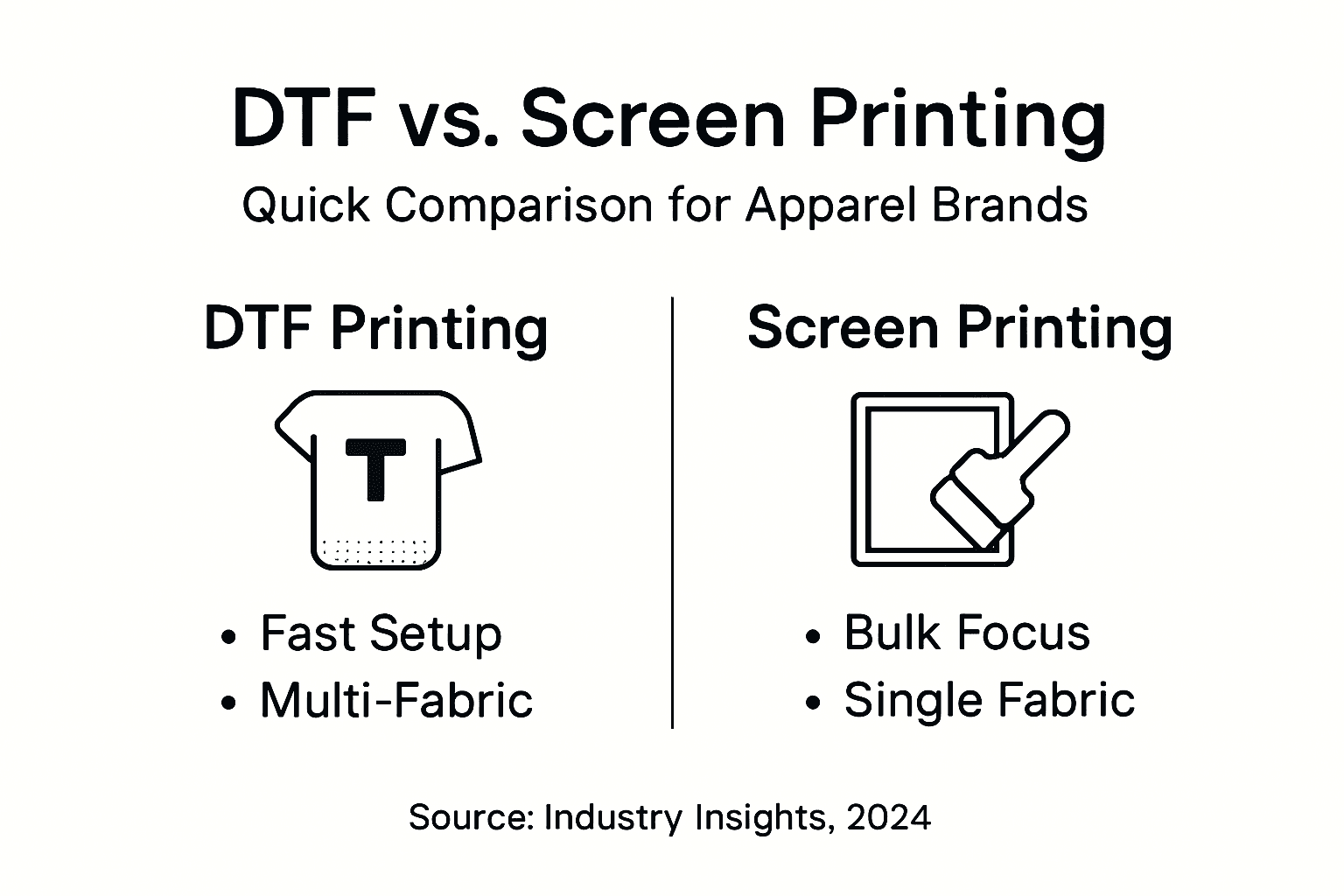
Here’s how DTF printing compares to traditional screen printing methods:
| Aspect | DTF Printing | Screen Printing |
|---|---|---|
| Setup Time | Minimal | Lengthy |
| Design Complexity | High, unlimited | Limited by screens |
| Suitable Fabrics | Cotton, blends, poly | Mostly cotton & blends |
| Production Run Size | On-demand to large | Mainly large batches |
| Eco-Friendliness | Improved with water-based inks | More waste, higher chemical use |
Pro tip: Invest in high-quality transfer films and calibrate your heat press settings precisely to achieve optimal DTF print transfer results.
Key Innovations Driving DTF Printing Trends
The digital textile printing landscape is experiencing rapid transformation, with DTF technology at the forefront of groundbreaking advancements. One-step digital textile technologies are revolutionizing production processes, enabling more efficient and streamlined printing workflows for apparel brands of all sizes.
Key innovations are emerging across multiple dimensions of DTF printing. Pigment ink developments have significantly improved print durability and fabric handling, while new equipment designs are reducing energy consumption and production times. Manufacturers are now focusing on creating more compact, versatile printing systems that can handle complex design requirements with greater precision and speed.
Sustainability has become a critical driver of innovation in DTF printing technologies. Advanced machines now optimize ink usage, minimize water waste, and support shorter production runs with reduced environmental impact. These technological improvements are particularly valuable for small to medium-sized apparel brands seeking to balance quality, cost-effectiveness, and ecological responsibility.
Pro tip: Research and invest in DTF printing equipment that offers modular design capabilities, allowing for future upgrades and technological adaptations without complete system replacement.
Evolving Applications Across Apparel Markets
DTF printing technology is dramatically expanding the boundaries of textile customization and production across diverse market segments. Custom apparel production techniques are transforming how brands approach design, manufacturing, and personalization of clothing items.
The versatility of DTF printing enables unprecedented flexibility across multiple apparel markets. Fashion boutiques now leverage this technology for limited edition designs, while sportswear manufacturers can produce intricate team uniforms with vibrant, durable graphics. Industrial workwear sectors benefit from prints that withstand frequent washing, and promotional clothing businesses can create complex, multicolor designs without traditional screen printing limitations.

From cotton t-shirts to polyester performance wear, DTF technology supports an extraordinary range of fabric types and product categories. Emerging markets like festival wear, personalized athletic gear, and niche fashion segments are particularly benefiting from DTF’s ability to produce high-resolution, stretch-resistant prints without extensive pre-treatment processes. This technological advancement allows smaller brands and individual designers to compete with larger manufacturers by reducing setup costs and enabling on-demand production.
Pro tip: Explore multiple fabric substrates and test print compatibility to maximize the versatility of your DTF printing capabilities.
Sustainability Practices and Eco-Friendly Inks
The digital textile printing industry is experiencing a significant shift towards more environmentally responsible manufacturing practices, with DTF printing leading the way in sustainable innovation. DTF printing sustainability efforts are transforming how apparel brands approach environmental responsibility and production efficiency.
Manufacturers are increasingly developing water-based ink formulations that dramatically reduce chemical usage and environmental impact. These eco-friendly inks are designed to minimize toxic emissions, reduce water consumption, and provide comparable print quality to traditional petroleum-based alternatives. Advanced ink technologies now enable apparel brands to achieve vibrant, long-lasting prints while significantly reducing their carbon footprint and supporting more sustainable production models.
The sustainability transformation extends beyond ink composition to encompass entire production workflows. Modern DTF printing systems are being engineered with energy-efficient components, waste reduction mechanisms, and recyclable transfer film technologies. Small to medium-sized apparel brands can now access printing solutions that not only meet environmental standards but also provide economic advantages through reduced material waste and lower energy consumption.
Pro tip: Prioritize DTF printing equipment and ink suppliers who transparently demonstrate their environmental certifications and sustainability metrics.
Impacts on Cost, Quality, and Production Speed
DTF printing technology is rapidly transforming manufacturing economics for apparel brands by delivering unprecedented improvements in production efficiency. Direct film printing market dynamics demonstrate significant advancements in reducing operational costs while maintaining superior print quality.
Cost efficiencies emerge through multiple channels in DTF printing. By minimizing material wastage, reducing setup times, and enabling on-demand production, brands can dramatically lower per-unit manufacturing expenses. Advanced printhead technologies and optimized ink formulations allow for faster processing speeds, with multi-head printers capable of handling both small batch and large-scale production requirements without compromising print resolution or color vibrancy.
Quality control in DTF printing has reached new heights through precise parameter optimization. Manufacturers can now fine-tune variables like heat press temperature and dwell time to minimize defects, enhance color durability, and produce consistently high-quality prints. These technological improvements mean apparel brands can achieve professional-grade results with reduced waste and increased production flexibility, effectively bridging the gap between custom design and mass production capabilities.
Pro tip: Invest in calibration equipment and regularly test print parameters to maintain optimal print quality and minimize production variations.
Common Pitfalls and How to Avoid Them
DTF printing presents several nuanced challenges that can significantly impact production quality and efficiency. DTF printing problem prevention requires a comprehensive understanding of potential environmental and technical complications that can compromise print outcomes.
Environmental factors play a critical role in successful DTF printing. Humidity and temperature fluctuations can dramatically affect ink drying, adhesive powder distribution, and overall print adhesion. Maintaining a controlled workspace with consistent temperature between 68-75 degrees Fahrenheit and humidity levels around 45-55% is crucial. Manufacturers must invest in climate control equipment and implement rigorous monitoring systems to prevent variations that could compromise print quality.
Consumables and equipment maintenance represent another significant area of potential failure. Low-quality transfer films, substandard inks, and inconsistent adhesive powders can lead to unpredictable print results. Professional apparel brands should prioritize sourcing high-grade materials from reputable manufacturers, establish strict quality control protocols, and develop regular maintenance schedules for printing equipment. This includes routine printhead cleaning, calibration checks, and systematic replacement of wear components to prevent unexpected production interruptions.
Use this table to quickly reference common DTF printing issues and solutions:
| Issue | Likely Cause | Solution |
|---|---|---|
| Uneven print adhesion | Humidity fluctuations | Maintain stable environment |
| Color fading after washing | Low-quality inks or film | Use certified consumables |
| Printhead clogging | Infrequent maintenance | Clean printhead regularly |
| Blurry or misaligned images | Incorrect heat transfer | Calibrate press settings |
Pro tip: Create a comprehensive equipment maintenance log and schedule regular preventative checks to catch potential issues before they escalate into costly production problems.
Elevate Your Apparel Brand with Cutting-Edge DTF Transfers
The challenge of staying ahead in the fast-evolving world of Direct-to-Film printing requires not only understanding industry trends but also having access to reliable, high-quality resources. If you want to overcome common pain points such as high setup costs, limited customization options, and inconsistent print quality, explore DTF transfers, custom apparel printing, heat transfers, t-shirt printing, high-quality prints. – Transfer Kingz. Here you can find premium transfer films and inks that help you achieve vibrant, durable designs with quick turnaround times and minimum hassle.
Ready to boost your apparel production speed, reduce waste, and tap into sustainable printing technology trends? Visit Transfer Kingz now to upload your designs or start creating custom prints that meet your exact needs. For even more printing supplies and versatile products, check out our full DTF transfers, UV DTF Permastickers, custom printing supplies, heat transfers, bulk printing. – Transfer Kingz collection to stay empowered in this competitive space. Get started today and bring your apparel vision to life with confidence.
Frequently Asked Questions
What is DTF printing technology?
DTF printing, or Direct-to-Film printing, is a digital textile printing method that transfers designs onto fabrics using water-based inks and specialized heat transfer films, resulting in vibrant and durable prints.
How does DTF printing compare to traditional screen printing?
DTF printing offers minimal setup time, the ability to print complex designs on various fabrics, and is suitable for both small and large production runs, unlike screen printing, which is typically limited to larger batches and has a longer setup time.
What are the benefits of using DTF printing for apparel brands?
DTF printing provides flexibility, high-quality output, and reduced operational costs due to its on-demand production capabilities and lower material waste, making it ideal for both small and medium-sized apparel brands.
How can brands ensure the quality of their DTF prints?
To ensure high-quality DTF prints, brands should invest in high-grade consumables, maintain a controlled printing environment, calibrate their heat press settings accurately, and perform regular maintenance on their printing equipment.


