

Finding reliable ways to decorate apparel that actually meet both budget and quality expectations can be tricky for many small brands. When every dollar and hour counts, understanding custom transfers is crucial for maintaining control over production while staying competitive. This guide clears up the confusion around what custom transfers really are and addresses the common myths so you can make the smartest decision for your brand’s next collection.
Table of Contents
- Defining Custom Transfers And Common Misconceptions
- Types Of Custom Transfers And Dtf Process
- Unique Benefits For Apparel Brands
- Cost, Turnaround, And Application Considerations
- Custom Transfers Vs. Other Printing Methods
Key Takeaways
| Point | Details |
|---|---|
| Understanding Custom Transfers | Custom transfers are a flexible printing method that applies pre-printed designs to fabric using heat and pressure, offering creative freedom for apparel brands. |
| Durability Myth | High-quality transfers bond well with fabric and are as durable as screen printing when applied correctly, countering the misconception of them being temporary. |
| Design Limitations | Transfers handle complex designs including full-color artwork with no setup fees, making them advantageous over traditional printing methods. |
| Cost Efficiency | Custom transfers eliminate minimum order quantities and setup fees, enabling brands to test designs with low financial risk and reduced waste. |
Defining Custom Transfers and Common Misconceptions
Custom transfers aren’t just a printing method—they’re a complete system for decorating apparel with precision and flexibility. Understanding what they actually are and dispelling myths about them is essential before you invest in this technology for your brand.
What Custom Transfers Really Are
Custom transfers are pre-printed designs on special film that transfer onto fabric through heat and pressure. They’re not stickers, screen printing, or embroidery. The design gets printed directly onto a film using specialized inks, then adheres permanently to the garment when applied with heat.
This process combines design flexibility with production speed. You can print individual pieces without minimum orders, making it perfect for small brands testing new designs or running limited drops.
Common Misconception #1: Transfers Are Temporary
Many brand owners worry transfers will peel, fade, or crack after a few washes. This isn’t accurate. High-quality transfers bond chemically with fabric fibers, creating durability comparable to screen printing when applied correctly.
The misconception likely stems from cheap transfer methods like iron-on vinyl. Those fail quickly. Professional DTF transfers use premium films and adhesives that withstand hundreds of washes.
Common Misconception #2: They Look Cheap or Plasticky
Some assume custom transfers create that obvious, fake-looking finish. In reality, modern transfers produce soft, breathable results that feel natural on skin. The design integrates into the fabric rather than sitting on top of it.
The quality depends entirely on your transfer supplier and application technique. Low-end transfers look bad. Premium transfers disappear into the garment.
Common Misconception #3: Custom Transfers Are Only for Small Orders
While they excel at small batches, knowledge transfer complexity extends beyond simple operations—transfers work equally well for bulk production. Many large manufacturers use them alongside screen printing for specific applications.
You’re not limited to small quantities. Scale them up whenever demand justifies it.
Common Misconception #4: Limited Design Possibilities
Transfers can handle complex artwork, photorealistic images, metallic accents, and multi-color designs with no setup costs. The only real limitation is fabric type—they work best on cotton blends, polyester, and nylon, but struggle on heavy canvas.
Design flexibility is actually one of their biggest advantages over traditional methods.
The Real Benefits Worth Understanding
- No minimum order quantities required
- Fast turnaround times (often 48-72 hours)
- Zero setup fees regardless of design complexity
- Photorealistic color reproduction
- Works on dark, light, and colored fabrics equally well
- No screen burning or disposal costs
Custom transfers remove the financial barriers that typically stop small brands from testing new designs or launching seasonal collections.
The key difference between transfers and other decoration methods comes down to understanding transfer process accuracy in application and material selection. Each method has legitimate use cases. Transfers excel when you need speed, flexibility, and low commitment.
Pro tip: Start with a small test order on your actual apparel to see the quality firsthand before committing to large quantities. This reveals how the transfer feels, looks, and performs with your specific garments.
Types of Custom Transfers and DTF Process
Direct-to-Film (DTF) transfers dominate the custom apparel space today, but understanding the different transfer types and how the DTF process works helps you choose the right method for your brand. Each approach has distinct advantages depending on your production needs and design requirements.
Understanding DTF Transfers
DTF is a digital printing method where designs print onto special film first, then transfer to fabric using heat and pressure. Unlike screen printing, which requires separate screens for each color, DTF handles full-color artwork in a single step with no minimum orders.
The process works on cotton blends, polyester, nylon, and even performance fabrics. You avoid fabric pre-treatment, which saves time and reduces material waste.
The Step-by-Step DTF Process
Direct-to-film printing involves multiple precision steps to create durable, vibrant transfers. Here’s how the journey from design to finished garment flows:
- Digital design creation using standard graphic software
- Mirrored CMYK printing on specialized transfer film
- White ink layer application for opacity and coverage
- Thermoplastic powder coating for adhesion strength
- Heat curing to set the powder properly
- Heat-pressing the film directly onto the garment
- Film peeling to reveal the final design
- Final curing for maximum durability
Each step matters. Skip or rush any phase, and transfer quality suffers.
Key Advantages of the DTF Process
DTF printing delivers flexibility that traditional methods can’t match. Consider these benefits:
- No color separations or screen burning needed
- Full photorealistic color reproduction in single pass
- Works equally well on dark and light fabrics
- Zero setup fees regardless of design complexity
- 48-72 hour typical turnaround times
- Batch printing of 1 to 1,000+ pieces at same price per unit
DTF transfers enable small brands to compete with larger manufacturers without minimum order requirements or expensive setup costs.
The specialized inks and powder adhesives bond directly with garment fibers, creating transfers that withstand repeated washing and wear. Quality DTF transfers last as long as the garment itself when applied correctly.
Other Transfer Types Worth Knowing
While DTF dominates for most applications, other transfer technologies serve specific niches:
- Heat Transfer Vinyl (HTV) – Best for simple, single-color designs; limited to 2-3 colors practically
- Screen Printed Transfers – Traditional method; economical for massive volume runs over 500 units
- Embroidered Patches – Premium look; expensive per unit, best for branding details
- Direct-to-Garment (DTG) – Prints directly on shirt; limited to light-colored fabrics
DTF outperforms these alternatives for most small to mid-sized brands because it balances cost, quality, turnaround, and versatility.
To clarify which transfer types suit different needs, see this practical comparison:
| Transfer Type | Best Use Case | Design Details | Typical Drawback |
|---|---|---|---|
| DTF Transfers | All-over color designs | Complex, full-color, photo | Requires heat press equipment |
| HTV | Simple logos, text | 1-3 color, basic shapes | Limited detail, fades faster |
| Screen Printed Transfers | High-volume basic designs | Simple color blocks | High setup cost, not flexible |
| Embroidered Patches | Premium, textured branding | Text, logos, small areas | High cost, slow turnaround |
| DTG | Soft finish on light shirts | Photo prints, art on white | Light fabrics only, costly gear |
Pro tip: Request sample transfers on your exact apparel before committing to production runs, since fabric weight and blend affect how transfers feel and perform during wear.
Unique Benefits for Apparel Brands
Custom transfers deliver advantages that traditional apparel production methods simply cannot match. For small to mid-sized brands, these benefits translate directly into competitive advantages, cost savings, and the ability to scale operations without massive capital investment.
Cost Efficiency and Reduced Waste
Custom transfers eliminate the financial barriers that prevent brands from launching new designs. No setup fees, no color separations, no minimum orders—you print one shirt or one thousand at identical per-unit costs.
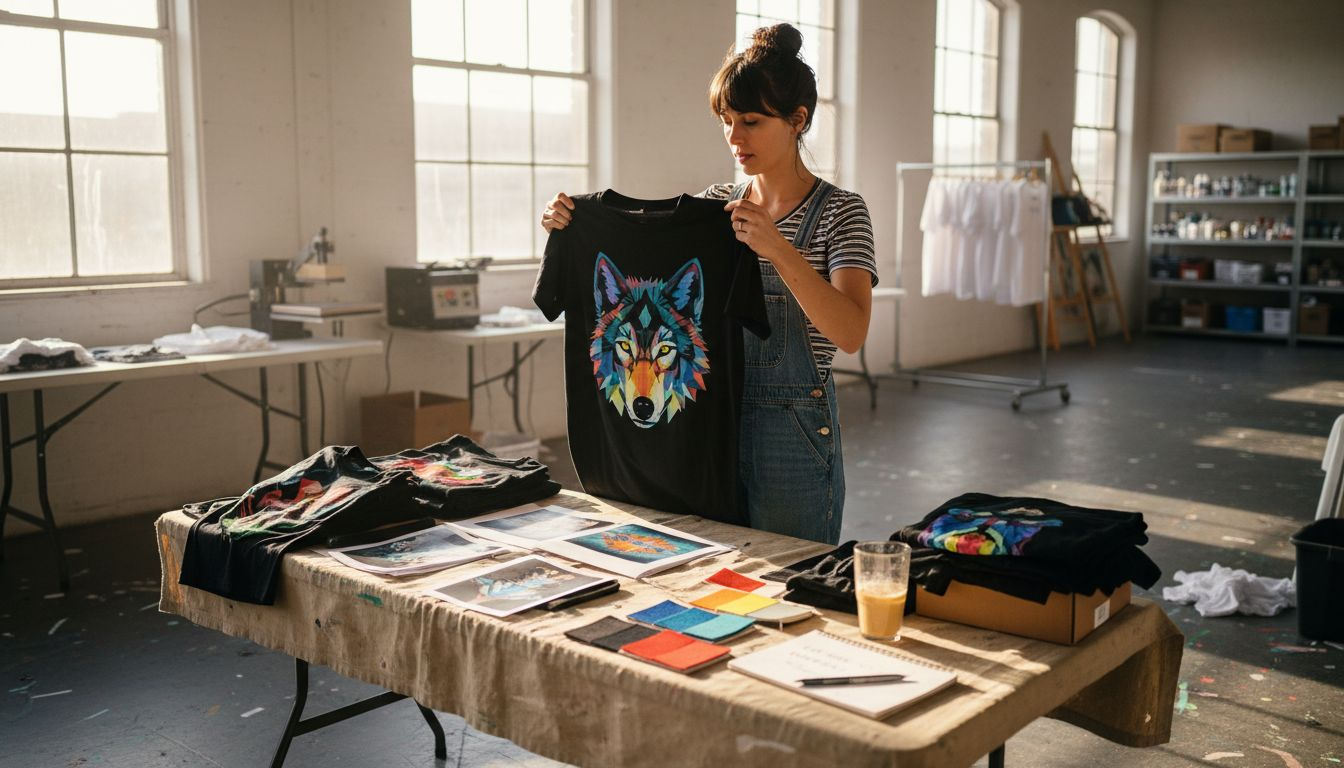
This flexibility drives down excess inventory. Brands can test designs with small batches before committing to larger runs, reducing waste and storage costs significantly.
Design Flexibility and Speed to Market
You’re no longer locked into lengthy production timelines. Custom transfers enable rapid prototyping and short production runs that respond to fashion trends immediately. When a design trend surfaces, your brand can capitalize on it within days, not months.
Complex artwork, photorealistic images, and multi-color designs require zero additional setup. Design complexity doesn’t increase costs or turnaround time.
Sustainability and Environmental Benefits
On-demand production reduces waste and lowers your brand’s carbon footprint compared to traditional bulk manufacturing. Custom transfers consume less water and energy than conventional printing methods, aligning with consumer expectations for eco-conscious brands.
This advantage matters increasingly to shoppers. Sustainability messaging backed by actual practices strengthens brand loyalty and justifies premium pricing.
Quality Control and Consistency
Every transfer prints identically. Color accuracy remains consistent across batches, eliminating the quality variations common in traditional production. Your brand maintains reliability customers expect, order after order.
Key Benefits Summary
- Zero setup fees regardless of design complexity
- No minimums on order quantities
- 48-72 hour turnaround on most orders
- Photorealistic color reproduction on any fabric
- Lower water and energy usage than screen printing
- Reduced inventory waste through on-demand production
- Rapid design testing before committing to volume
Customized production capabilities let brands scale operations while meeting climate goals and reducing operational costs simultaneously.
Small brands can now compete with established manufacturers. You gain operational efficiency, design freedom, and sustainability credentials—advantages that once required massive production facilities and capital investment.
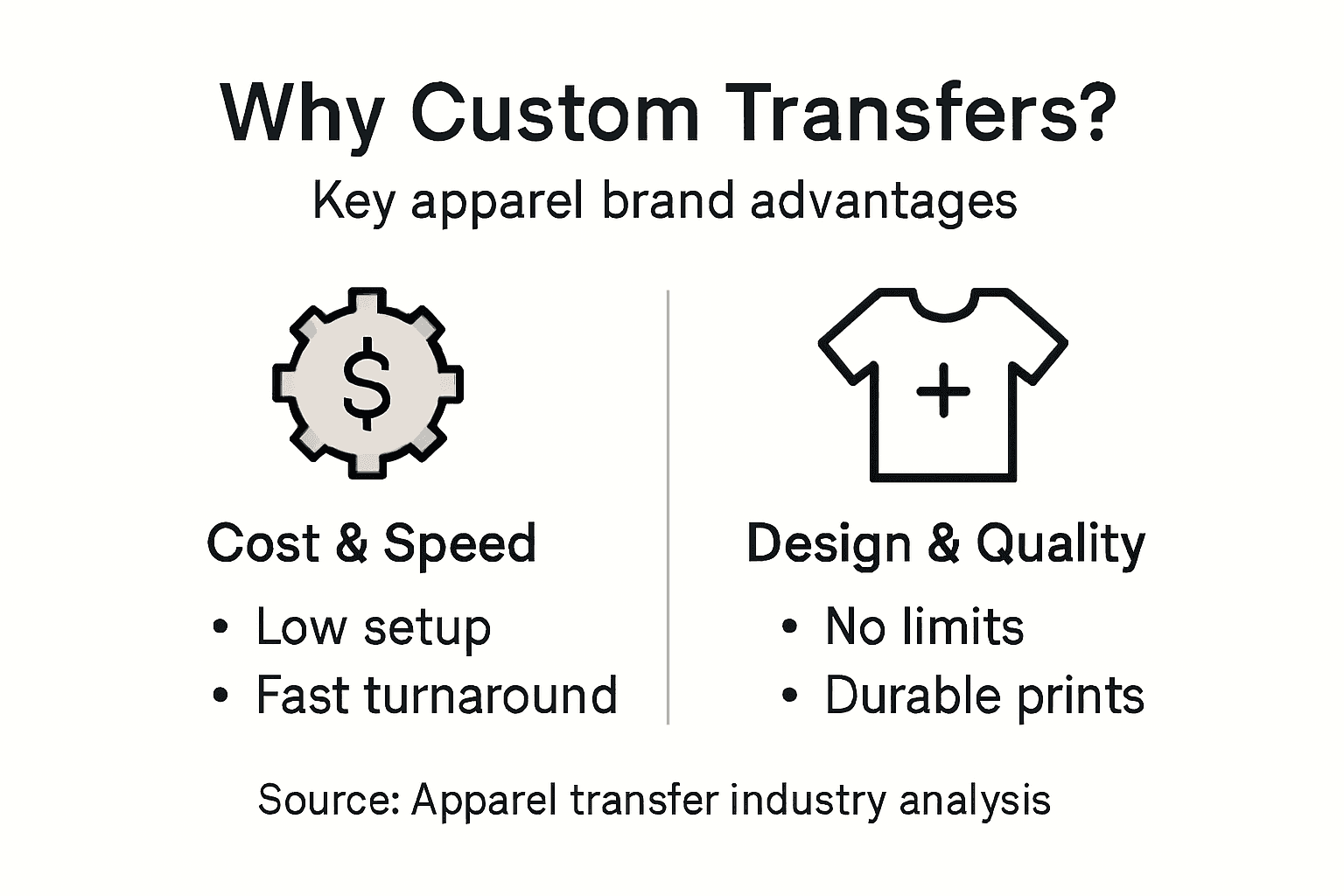
This overview details how DTF transfers benefit apparel brands at each stage:
| Business Stage | DTF Transfer Impact | Key Strategic Advantage |
|---|---|---|
| Launch/Test Collection | Fast, low-risk prototyping | Launch new styles economically |
| Growing Brand | Scale as needed | Add designs without setup delays |
| Established Manufacturer | Flex for small runs | Supplement bulk with quick turns |
| Eco-Conscious Shop | Reduce waste, footprint | Align with green commitments |
Real-World Impact for Your Brand
Imagine testing five different hoodie designs with 25 units each before placing a 500-unit production order. Traditional methods make this scenario financially impossible. Custom transfers make it standard practice.
Your profit margins improve. Your inventory risk decreases. Your time to market accelerates. Your environmental footprint shrinks.
Pro tip: Track your actual costs per garment across design variations and seasonal runs to quantify your savings compared to traditional manufacturing—these numbers become powerful sales tools when pitching wholesale partnerships.
Cost, Turnaround, and Application Considerations
Choosing custom transfers for your apparel brand requires understanding three critical factors: what you’ll pay, how fast you’ll receive orders, and how easily they apply to your garments. Getting these right directly impacts your profitability and customer satisfaction.
Understanding Pricing Structure
Custom transfer pricing differs fundamentally from traditional apparel production. You pay per transfer, not per setup. A single shirt costs roughly the same as 500 shirts when ordered simultaneously.
Factors affecting your per-unit cost include design complexity, fabric type, order quantity, and rush fees. Most suppliers offer tiered pricing—larger orders reduce per-unit costs slightly, but minimums don’t exist.
Cost Breakdown for Budgeting
Understanding where your money goes helps you make informed decisions:
- Transfer cost per unit – typically $3 to $12 depending on size and design
- Shipping – varies by location and order weight
- Rush fees – applied if turnaround under 48 hours
- Blank apparel – your separate cost from garment supplier
- Labor application – your time or staff applying transfers
Total landed cost per finished garment stays competitive with screen printing for most brands.
Turnaround Times and Planning
Cost and turnaround efficiency depend on order volume and production scheduling. Standard turnaround runs 3-5 business days for most orders. Rush options typically deliver in 24-48 hours at premium rates.
Planning ahead saves money. A one-week lead time usually costs less than 48-hour rush fees.
Application Considerations and Requirements
Transfers require proper application technique to maximize durability and appearance. Heat, pressure, and time must meet precise specifications. Poor application ruins otherwise excellent transfers.
Consider these application factors:
- Heat press access – necessary equipment investment
- Temperature settings – vary by fabric and transfer type
- Dwell time – typically 10-15 seconds per application
- Cooling period – critical for proper adhesion
- Peel technique – cold or warm peel depending on transfer type
- Labor training – staff must follow exact procedures
Fabric Compatibility
Transfers work beautifully on most fabrics, but compatibility matters. Cotton blends, polyester, and nylon accept transfers without special preparation. Heavy canvas and rigid materials present challenges.
Test transfers on your exact apparel before committing to large orders. Fabric weight, weave, and finish affect how transfers feel and perform.
Managing Expectations and Quality
Operational efficiency balances speed, cost, and quality—rushing often sacrifices one or both of the others.
Rushed orders sometimes skip proper curing steps. Small orders may have higher per-unit costs than bulk runs. Complex designs occasionally need longer production windows for quality control.
Understanding these trade-offs helps you set realistic timelines and budgets.
Cost-Saving Strategies
- Order during off-peak periods for potential discounts
- Batch similar designs together for streamlined production
- Plan campaigns 2+ weeks ahead to avoid rush fees
- Test designs with minimal quantities before scaling
- Work with suppliers offering volume discounts on recurring orders
Pro tip: Request detailed application instructions specific to your garment type and keep them accessible during production—correct technique eliminates the most common causes of customer complaints about transfer durability.
Custom Transfers vs. Other Printing Methods
Understanding how custom transfers compare to other printing methods helps you choose the right solution for your specific needs. Each method excels in different scenarios, and knowing the differences prevents costly mistakes.
Screen Printing: The Traditional Standard
Screen printing remains popular for high-volume orders because per-unit costs drop significantly at scale. However, setup costs run $75 to $200 per color, making small orders economically unfeasible.
Screen printing handles simple designs beautifully but struggles with photorealistic images or complex multi-color artwork. Color separations add time and cost.
Heat Transfer Vinyl (HTV): Simple and Limited
HTV works well for single-color designs, logos, and text on t-shirts and hoodies. Application is straightforward and requires minimal equipment investment.
The trade-off is significant. HTV can handle 2-3 colors maximum before becoming impractical. Complex artwork, gradients, and photorealistic images aren’t viable. Durability also suffers compared to other methods.
Direct-to-Garment (DTG): Direct Application
DTG printing applies ink directly to the garment without transfers. No heat pressing required, and application is quick. Results feel soft against skin.
DTG works only on light-colored fabrics and cotton-dominant blends. Dark shirts result in poor color accuracy. Equipment costs run $15,000 to $25,000, making it unaffordable for small brands.
Embroidery: Premium Positioning
Embroidery creates durable, high-end finishes that justify premium pricing. Customers perceive embroidered items as more valuable and professional.
Embroidery requires expensive digitization and setup. Per-unit costs stay high even at volume. Complex designs become impractical or impossible to execute.
Why Custom Transfers Stand Out
Custom transfers occupy the sweet spot for most small to mid-sized apparel brands:
- No setup fees – print one or 1,000 at identical unit costs
- Full-color capability – photorealistic images in single application
- Works on any fabric – dark, light, blends, performance materials
- Fast turnaround – 48-72 hours standard
- Equipment affordable – basic heat press under $500
- Design flexibility – unlimited color options
Comparison Table: Quick Reference
| Method | Setup Cost | Min. Order | Colors | Speed | Per-Unit Cost |
|---|---|---|---|---|---|
| Screen Print | $75-200 | 50+ | Limited | Slow | Low (high volume) |
| HTV | $0 | 1 | 2-3 max | Fast | Medium |
| DTG | $15-25K | 1 | Unlimited | Medium | High |
| Custom Transfers | $0 | 1 | Unlimited | Fast | Low-Medium |
| Embroidery | $50-150 | 1 | Limited | Slow | High |
When Thermal-transfer printing or other specialized methods matter—those work best for labeling and product identification, not apparel decoration. Custom transfers outperform them for clothing applications because they handle the design complexity, fabric variety, and turnaround demands that apparel brands require.
Custom transfers deliver the versatility of digital printing with the durability of traditional methods, making them ideal for brands testing designs or scaling production rapidly.
The choice depends on your priorities. Need massive volume at rock-bottom per-unit cost? Screen printing wins. Want design flexibility without equipment investment? Custom transfers dominate.
Pro tip: Create a simple cost analysis comparing total invested money (setup plus per-unit costs) for 100, 500, and 1,000 unit orders across printing methods—this reveals which method becomes most economical at your typical order volumes.
Unlock the Power of Custom Transfers with Transfer Kingz
Struggling with costly setup fees and minimum order requirements that slow your apparel brand down Custom transfers offer the flexibility and affordability you need to test new designs and scale your production fast. With Transfer Kingz’s premium DTF transfers, custom apparel printing, heat transfers, t-shirt printing, high-quality prints, you gain access to vibrant, durable transfers that last wash after wash while allowing unlimited design freedom.
Experience fast turnaround times and zero minimum order quantities so you can launch collections quickly or fulfill small runs economically. Visit Transfer Kingz to upload your artwork today or explore our full range of DTF transfers, UV DTF Permastickers, custom printing supplies, heat transfers, bulk printing for all your apparel decoration needs. Start elevating your brand with cutting-edge printing solutions now and see how simple it is to turn ideas into high-quality, wearable art.
Frequently Asked Questions
What are custom transfers and how do they work?
Custom transfers are pre-printed designs on a special film that transfer onto fabric through heat and pressure. The design is printed directly onto the film using specialized inks and adheres permanently to the garment when applied with heat.
Are custom transfers durable and long-lasting?
Yes, high-quality custom transfers bond chemically with fabric fibers, creating durability similar to screen printing when applied correctly. They can withstand hundreds of washes without peeling, fading, or cracking.
What advantages do custom transfers have over screen printing?
Custom transfers offer zero setup fees, no minimum order quantities, and faster turnaround times. They can also handle complex artwork and full-color designs without additional costs, making them ideal for small to mid-sized apparel brands.
Can I use custom transfers on any fabric type?
Custom transfers work best on cotton blends, polyester, and nylon. They may struggle on heavy canvas or rigid materials, so it’s important to test transfers on your specific fabric before large orders.
0 comments