

TL;DR:
- B2B apparel printing enables small businesses to produce professional-grade apparel at scale without high overhead costs. It offers versatile techniques like DTF that support bulk, custom, and seasonal orders, enhancing brand growth and flexibility. Choosing a reliable partner with diverse techniques, clear timelines, and quality guarantees ensures consistent, efficient, and scalable production for emerging brands.
Custom apparel printing isn’t just for big retail chains or direct-to-consumer brands flooding social media feeds. Small business owners, independent decorators, and boutique brand operators are discovering that B2B apparel printing gives them access to the same professional-grade results that larger companies rely on, without the massive overhead. If you’ve assumed that outsourcing your printing to a business-focused provider was too complicated, too expensive, or only worth it at high volumes, it’s time to rethink that assumption. This guide walks you through what B2B apparel printing actually is, how it works, and how to use it strategically to grow your brand.
Table of Contents
- Understanding B2B apparel printing
- Common printing techniques for B2B apparel
- Major advantages of B2B apparel printing
- How to choose the right B2B apparel printing partner
- The real value of B2B apparel printing for small brands
- Elevate your brand with trusted B2B apparel printing solutions
- Frequently asked questions
Key Takeaways
| Point | Details |
|---|---|
| What B2B printing is | B2B apparel printing lets businesses outsource custom garment production to professional providers for efficiency and quality. |
| Top techniques compared | Understand the strengths of DTF, screen printing, DTG, and heat transfer to select the best method for your needs. |
| Scalable, cost-effective | Using B2B providers helps you save on costs, meet demand surges, and scale without big investments in equipment. |
| Choosing a partner | Evaluate providers for print quality, service options, and reliability to avoid common outsourcing pitfalls. |
Understanding B2B apparel printing
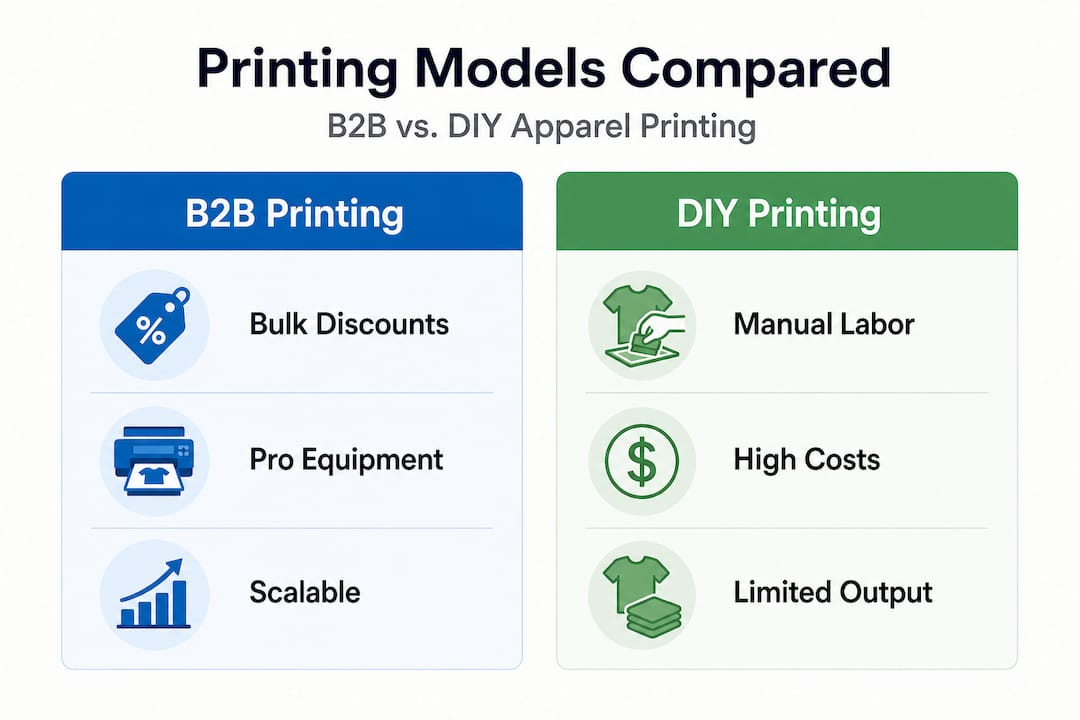
B2B apparel printing, short for business-to-business apparel printing, refers to the model where one business (a print provider or decorator) offers printing services directly to another business (a brand owner, merch seller, or reseller) rather than to an individual consumer. Instead of a customer ordering a single personalized shirt, a boutique brand orders 200 branded tees for a product launch. The client is a business, and the service is built around business needs.
The key distinction from consumer print services is the relationship and the infrastructure behind it. B2B providers are set up to handle things like bulk orders, recurring production cycles, white-label fulfillment, and account-level customer support. A B2C print shop focuses on quick one-off orders. A B2B printer focuses on becoming an extension of your production operation.
As outlined in DTF Printing for Business Branding, custom transfers and professional printing have become a practical branding tool for small businesses that want to present themselves professionally without running their own print shop. That shift has made B2B printing more accessible and relevant than ever.
Who uses B2B apparel printing? More people than you might expect:
- Boutique clothing brands producing seasonal runs of branded apparel
- Event organizers needing custom shirts, hats, or bags for conferences and festivals
- Merchandise sellers producing designs for music artists, podcasters, or content creators
- Promotional product companies filling corporate uniform and giveaway orders
- Apparel decorators who resell finished products to their own clients
- Print-on-demand entrepreneurs building scalable, low-risk product lines
“B2B apparel printing removes the barrier between having a great design and having a professional product in your customer’s hands. It’s the infrastructure that makes small brands look and operate like established ones.”
The benefits for small brands go well beyond just convenience. B2B printing unlocks scalability, meaning you can start small and increase volume as demand grows without changing your production setup. It also gives you access to equipment and processes that would cost tens of thousands of dollars to replicate in-house.
Common printing techniques for B2B apparel
Once you understand what B2B apparel printing is, the next natural question is: what printing method should you use? Not all techniques are equal, and the right one depends on your order size, budget, material type, and the visual complexity of your design.
Here’s a breakdown of the four most common methods used in B2B contexts:
| Method | Setup cost | Speed | Best order size | Print quality | Best use case |
|---|---|---|---|---|---|
| DTF (direct to film) | Low | Fast | Any size | Very high | Full-color, detailed designs on multiple materials |
| Screen printing | High | Fast at scale | 50+ units | High | Simple designs, high volume, bold colors |
| DTG (direct to garment) | Medium | Moderate | Small runs | Very high | Photo-realistic prints on cotton garments |
| Heat transfer (vinyl) | Low | Moderate | Small to medium | Good | Simple graphics, names, numbers |
According to the comparison of inkjet vs DTF printing, DTF has emerged as the most versatile method for businesses that need high-quality results across multiple fabric types without large minimum orders. That versatility makes it a standout choice for small brands and decorators working on mixed product lines.
The typical B2B printing workflow with a professional provider follows a predictable structure:
- Submit your artwork. Most B2B providers accept vector files or high-resolution artwork. Some offer design support or gang sheet builders to maximize print efficiency.
- Choose your method and product. Select the printing technique and garment type based on your design needs and volume.
- Receive a quote or place your order. B2B pricing is usually tiered, with better rates at higher quantities.
- Production and quality check. The provider prints your order, runs quality control, and packages products according to your requirements.
- Fulfillment or pickup. Finished goods ship directly to you or, if your provider offers white-label services, directly to your customers.
Current DTF printing trends show the industry is moving toward faster automated workflows, wider color gamuts, and eco-friendlier inks. Businesses that adopt these newer approaches now position themselves well ahead of competitors still relying on older methods. Watching DTF printing innovations closely will show you what’s coming next: better stretch performance on athletic fabrics, more sustainable film options, and tighter integration with e-commerce fulfillment platforms.
Pro Tip: Match your printing method to your actual production reality, not your ideal scenario. If you’re testing a new product line with uncertain demand, use a low-minimum method like DTF. Once a design proves popular and you’re ordering hundreds of units, explore screen printing for better cost efficiency at scale.
Major advantages of B2B apparel printing
Understanding the methods is important, but the “why” matters just as much. Here’s what makes B2B apparel printing genuinely worth it for small businesses and decorators.
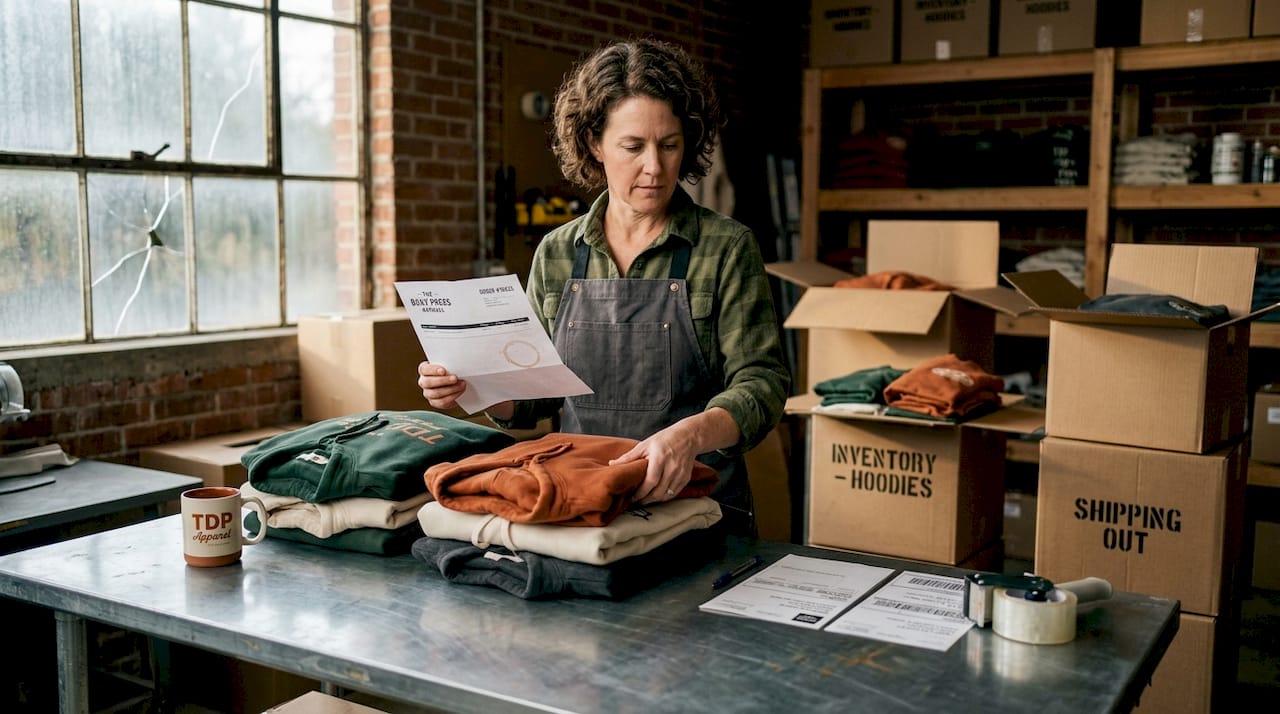
Cost efficiency through scale. One of the clearest advantages is pricing. B2B providers offer tiered pricing structures where your cost per unit drops significantly as your order volume increases. A single DTF transfer might cost several dollars individually, but ordering in bulk can cut that cost by 30 to 60 percent depending on the provider and order size.
| Order size | Estimated cost per unit (DTF) | Potential savings vs. small order |
|---|---|---|
| 1 to 10 units | $4.00 to $6.00 | Baseline |
| 25 to 50 units | $2.50 to $4.00 | Up to 35% savings |
| 100+ units | $1.50 to $2.50 | Up to 60% savings |
| 500+ units | $0.80 to $1.50 | Up to 75% savings |
As explored in bulk printing advantages, the cost savings from organized bulk orders go beyond just unit price. You’re also saving on administrative overhead, production time, and shipping consolidation. These soft savings add up fast when you’re running a lean operation.
Flexibility that DIY simply can’t match. Small businesses often assume they need to print everything themselves to maintain control. In reality, a reliable B2B printing partner gives you more flexibility. You can test new colorways, launch limited editions, or switch product types without investing in new equipment or retooling your own shop.
Consistent professional quality. Consistency is what separates a brand from a hobby. B2B providers maintain calibrated equipment, standardized processes, and repeatable color profiles. When your customer orders the same shirt twice, they should get the same vibrant print both times. That reliability builds brand trust. The custom apparel printing benefits for small brands show that consistent print quality is one of the top factors in repeat customer satisfaction.
Faster turnaround for launches and seasonal spikes. Most B2B printing providers are built to handle rush orders and peak season surges. If you’re dropping a limited collection for a holiday weekend or need branded apparel for an event next week, a professional B2B partner with the right infrastructure can deliver in ways a solo decorator or small in-house setup simply cannot.
Key advantages at a glance:
- No minimum order requirements with many modern B2B DTF providers
- Access to specialty finishes like glitter, neon, or glow-in-the-dark effects
- White-label fulfillment options to ship directly to your customers
- Consistent, predictable pricing that supports accurate product costing
- Reduced production stress so you focus on running your business
How to choose the right B2B apparel printing partner
Knowing the benefits is one thing. Finding a provider who actually delivers on them is another challenge entirely. Here’s what to evaluate before committing your brand’s production to any B2B print partner.
- Print technique variety. Does the provider offer multiple methods, or are they locked into one approach? A flexible provider can recommend the right method for each project rather than pushing everything through the same process.
- Turnaround time guarantees. Ask for specific production timelines, not vague estimates. Many reliable B2B providers offer standard 2 to 5 business day turnarounds and rush options for urgent orders.
- Minimum order requirements. Some traditional B2B printers require large minimums that don’t work for small businesses. Look for providers with no minimums or very low entry points so you can test before scaling.
- Sample availability. Always request a sample or test order before committing to a production run. A provider confident in their quality will welcome this step.
- Customer support quality. You want a partner who responds quickly, communicates clearly, and solves problems when they arise. A single bad production run can damage your brand’s reputation with customers who have no idea the issue was your printer’s fault.
- Pricing transparency. Watch for hidden fees on setup, color matching, or file preparation. Good providers quote clearly and upfront.
“Working with experienced B2B providers means your production doesn’t fall apart when demand spikes. Their infrastructure absorbs the pressure so yours doesn’t have to.”
High-quality transfers matter more than many decorators realize. Cheap transfers may look fine initially but fail after a few wash cycles, fade unevenly, or crack under pressure. That creates returns, complaints, and the kind of brand damage that’s hard to recover from. Quality upfront saves you far more than it costs.
For broader production strategy, print-on-demand tips can help you structure your workflow to reduce waste, cut costs, and build a more profitable apparel operation.
Pro Tip: Before placing a large order, send a small test run that includes your most demanding design, the one with the most colors, gradients, or fine detail. If a provider handles that well, they’ll handle everything else without trouble.
The real value of B2B apparel printing for small brands
Here’s something most articles about B2B apparel printing won’t tell you: the biggest advantage isn’t cost. It’s speed to creativity.
When you’re not managing printing equipment, sourcing consumables, or troubleshooting production issues, your mental bandwidth opens up. That’s when the interesting business moves happen. A small streetwear brand we’ve seen work through platforms like ours used DTF printing to test eight different graphic styles in a single month. They identified their bestseller quickly, doubled down on that aesthetic, and built a loyal customer base around it. None of that experimentation would have been financially viable if they’d been trying to print everything in-house.
The myth that outsourcing printing means losing control is exactly backwards. When you own a printer, you’re limited to what that machine can do. When you work with a skilled B2B partner, your production capabilities expand dramatically. Want to try puff transfers? A metallic design? A subtle vintage wash effect? A good B2B provider can execute all of those. A single-machine in-house operation cannot.
Small businesses also tend to underestimate the value of accessing commercial-grade technology. Digital printing empowers brands precisely because those brands can now use the same output quality that enterprise operations use, delivered through a flexible, scalable model that fits a lean business structure.
The real question isn’t whether B2B apparel printing is right for your business. It’s whether you can afford to keep operating without it.
Elevate your brand with trusted B2B apparel printing solutions
If you’re serious about growing your custom apparel brand, you need a print partner who can keep pace with your ambitions. That’s exactly what Print Point B2B solutions are built for. Fast turnarounds, no intimidating minimums, and a range of printing techniques mean you can test ideas quickly and scale what works.
Transfer Kingz supports small businesses and professional decorators with premium DTF transfers, intuitive gang sheet tools, and a team that understands production at every scale. Whether you’re placing your first business order or looking for a reliable production partner for your growing brand, reaching out for a sample or custom quote is a straightforward first step. Your next product launch deserves professional results from a partner who delivers consistently.
Frequently asked questions
What types of businesses use B2B apparel printing?
Small brands, merch sellers, event organizers, and designers use B2B apparel printing to outsource production and scale efficiently, as detailed in the DTF printing for business branding overview. Any business that wants professional results without managing its own print operation is a strong candidate.
How is B2B apparel printing different from ordering shirts as a consumer?
B2B apparel printing offers bulk pricing, advanced techniques, and services structured around business needs, as outlined in the custom apparel printing benefits guide. Consumer orders focus on single items while B2B relationships support recurring production at scale.
Which printing method is best for large apparel orders?
DTF and screen printing are both strong options for large orders due to their speed, cost efficiency, and output consistency, as covered in the inkjet vs DTF printing comparison. DTF is more versatile for mixed fabric types while screen printing excels on simple, high-volume designs.
What should I look for in a B2B print partner?
Prioritize technique variety, clear turnaround commitments, quality guarantees, and the ability to order samples before committing to production. High-quality transfers are a non-negotiable starting point when evaluating any new provider.
0 comments