

TL;DR:
- Custom apparel printing is highly accessible with low barriers for small brands.
- Small batch printing enables quick testing, market responsiveness, and zero inventory waste.
- Niche focus and strategic marketing are essential for success amid market competition.
Most small business owners and independent designers assume custom apparel printing is a game reserved for big brands with deep pockets and warehouse-sized minimum orders. That assumption is costing them real growth opportunities. The truth is, custom apparel printing is one of the most accessible and powerful tools available to small brands right now, and the barrier to entry has never been lower. Whether you are testing a new product line, launching a seasonal campaign, or building a loyal community around your brand, custom printing gives you the speed, flexibility, and cost control to compete without overcommitting your budget.
Table of Contents
- How custom apparel printing empowers small brands
- Boosting brand visibility and customer loyalty
- Cost efficiency: No inventory waste, pay-as-you-go
- Navigating challenges: Competition and finding your niche
- The hard truths most overlook about custom apparel printing
- Scale your apparel brand with expert printing services
- Frequently asked questions
Key Takeaways
| Point | Details |
|---|---|
| Agility for small brands | Custom apparel printing lets you launch and test new designs quickly without inventory risk. |
| Boosts brand loyalty | Personalized merchandise creates customer engagement and transforms buyers into brand advocates. |
| Cost-effective production | On-demand printing only charges for what you sell, helping you avoid surplus inventory and cash flow issues. |
| Market is growing fast | The custom apparel market is booming, but niche focus and smart marketing are key to success. |
How custom apparel printing empowers small brands
With the foundation set, let’s explore how custom apparel printing specifically fuels business agility for independent designers and startups.
Here is one of the biggest misconceptions in the custom apparel space: you need large volumes to make it worthwhile. That is simply not true anymore. Today’s printing technology, especially Direct-to-Film transfers, has completely changed what is possible for a small operation. You can order a single shirt, a dozen hoodies, or a few hundred tote bags without locking yourself into expensive bulk commitments. That kind of freedom lets you move the way big brands cannot.
The advantages of custom transfers go far beyond just printing flexibility. When you remove the pressure of minimum order quantities, you can treat every product launch as a learning experiment. Launch a limited run. Gauge customer response. Adjust your design, your colorway, or your messaging before you scale. That process used to take months and thousands of dollars. Now it takes days and a fraction of the cost.
According to print-on-demand industry statistics, flexible design and product offerings allow brands to do quick launches, test niche markets, and eliminate inventory waste, making it ideal for independent designers who need to stay lean and responsive.
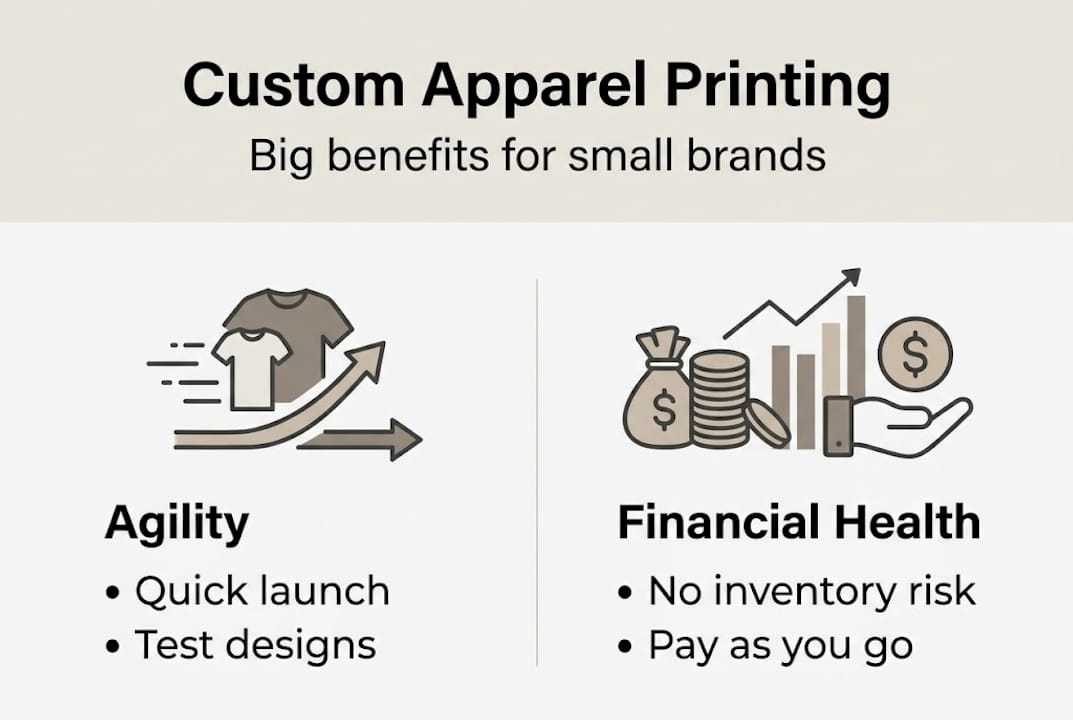
Here is what that agility looks like in practice:
- Flexible quantities: Order exactly what you need, from one piece to one thousand, without penalty.
- Fast prototyping: See a physical sample of your design within days, not weeks.
- Market responsiveness: React to trends, holidays, or viral moments before the window closes.
- Niche targeting: Create hyper-specific products for tight communities without worrying about mass appeal.
- Zero dead stock: If a design does not sell, you have not wasted inventory. You have gained data.
Pro Tip: Build a feedback loop into every launch. Share your new design with a small segment of your audience before a full rollout. Use their responses to fine-tune sizing, colorways, and messaging. This approach, paired with expert print-on-demand tips, turns every small batch into a strategic step toward a stronger product line.
The power of agility cannot be overstated for independent designers. Big brands move slowly because they are managing massive supply chains, complex approval processes, and enormous inventory positions. You do not have those constraints. That is your competitive edge, and custom apparel printing is how you use it.
Boosting brand visibility and customer loyalty
Beyond agility, let’s discuss how custom apparel strengthens your brand’s identity and customer relationships.
Think about what happens when a customer wears your branded tee out in public. They become a walking advertisement. They signal their identity to their community. They are not just buying a shirt; they are buying into what your brand represents. That is the deeper function of custom apparel, and it is something that business branding with custom DTF transfers achieves better than almost any other marketing channel.
The print-on-demand model also enables quick product launches that test whether your brand identity resonates with real customers, giving you live market data without risking your cash flow.
The path from idea to branded merchandise does not have to be complicated. Here is a straightforward process that works for most small brands:
- Define your brand aesthetic. Nail down your colors, typography, and the core feeling you want customers to associate with your brand before you design a single product.
- Translate your identity into apparel concepts. Think about what your audience actually wears and how your brand can fit naturally into their lifestyle.
- Create and test your designs. Use a print-on-demand or DTF transfer provider to produce small quantities and gather real feedback from real people.
- Launch with intention. Use email lists, social media, and community groups to build anticipation before your drop.
- Collect and act on feedback. Reviews, return rates, photos from customers wearing your gear. All of that is intelligence you can use to improve the next run.
Pro Tip: Limited-edition drops are one of the most effective tools in a small brand’s arsenal. When customers know a design is only available for a short window, perceived exclusivity drives urgency. This approach is especially powerful for digital printing for branding because you can run small batches affordably, making scarcity genuine rather than manufactured.
Consider a real-world example: a local coffee shop in Austin launched a small run of branded tees featuring a hand-drawn illustration of their flagship location. They ordered just 50 shirts to start. Within two weeks, those shirts had sold out, generated over 200 organic social media mentions, and brought in 40 new customers who came in specifically because they had seen someone wearing the shirt. The shop doubled their engagement rate on Instagram for the following month. That outcome was not about a massive marketing budget. It was about a tight, authentic brand identity expressed through a well-executed piece of custom apparel.
Cost efficiency: No inventory waste, pay-as-you-go
Brand growth is vital, but so is financial health. Here’s how custom printing protects your bottom line.
One of the most painful lessons in retail is ordering too much of a product that does not sell. Unsold inventory ties up your cash, takes up storage space, and eventually forces you into markdown pricing that erodes your margins. Custom apparel printing on demand eliminates that entire problem at the root.

The print-on-demand industry continues to grow because it solves a fundamental financial problem for small brands: you only pay for what you actually sell. There is no warehouse minimum, no large upfront production run, and no gamble on how many units the market will absorb.
Here is a direct comparison of what the two approaches look like side by side:
| Factor | On-demand custom printing | Bulk ordering |
|---|---|---|
| Upfront cost | Low, pay per unit | High, large minimum spend |
| Inventory risk | None | High if designs underperform |
| Design flexibility | Change anytime | Locked into ordered quantity |
| Storage needs | None | Warehousing required |
| Cash flow impact | Minimal | Significant capital tied up |
| Speed to market | Days | Weeks to months |
Beyond the obvious savings, there are hidden costs that bulk ordering creates and that on-demand printing helps you avoid entirely:
- Storage fees: Renting space or using fulfillment centers to hold inventory adds up fast.
- Markdown losses: Selling unsold stock at 50% off does not just hurt margins, it also trains customers to wait for sales.
- Design obsolescence: A trend-driven design ordered in bulk can become irrelevant before you sell through it.
- Opportunity cost: Cash locked in unsold inventory is cash you cannot use to market, innovate, or grow.
The custom t-shirt market is projected to reach $9.18 billion by 2030 with a 25.8% compound annual growth rate, which tells you this model is not a niche workaround. It is the direction the entire industry is moving. Understanding industry trends in custom printing will help you position your brand ahead of where the market is heading.
Consider an independent designer who committed to a bulk order of 500 units for a design she had not yet tested. When the product landed flat with her audience, she was stuck with nearly $4,000 in unsold merchandise. Compare that to a designer who used DTF transfers to produce 30 units, sold out, and reinvested the profit into a second, improved run. Understanding bulk printing advantages matters too, but the key is knowing when bulk makes sense versus when small-batch on-demand is the smarter play.
Navigating challenges: Competition and finding your niche
While there are big benefits, real risks exist. Let’s tackle the biggest ones and how you can prepare.
The print-on-demand and custom apparel space has exploded in the past few years. That growth creates enormous opportunity, but it also creates a crowded market where generic products get buried. Knowing this going in will save you a lot of frustration and wasted effort.
The data tells a sobering story: fewer than 20% of print-on-demand businesses are profitable in their first year, largely due to fierce competition and underinvestment in marketing. That does not mean you should not try. It means you need a smarter approach than most people start with.
At the same time, the opportunity is undeniable. The custom t-shirt market is growing at 25.8% annually, and the overall POD market hit $6.18 billion in 2022 with no signs of slowing. The brands that win are the ones who stop trying to appeal to everyone and start building products for specific, passionate groups.
Here is what the competitive landscape actually looks like:
| Metric | Industry reality |
|---|---|
| POD businesses profitable in year one | Less than 20% |
| Average time to breakeven | 12 to 18 months |
| Primary failure reason | Insufficient marketing and niche definition |
| Key success differentiator | Hyper-targeted audience focus |
To improve your odds meaningfully, follow these steps before you launch:
- Define your niche with precision. “Dog lovers” is too broad. “Rescue dog adopters who love retro aesthetics” is a niche. The narrower your focus, the easier it is to create products people feel deeply connected to.
- Research your audience before you design. Join the communities, forums, and social groups where your target customers spend time. Find out what they talk about, what they already wear, and what is missing in the market.
- Test small before you scale. Use a limited run to validate demand before expanding your product line. Comparing DTF vs inkjet printing methods can also help you choose the right production approach for your designs and budget.
- Invest in marketing from day one. A great product that nobody sees is not a business. Allocate real time and resources to building your audience before, during, and after your launch.
- Iterate relentlessly. Every product is a test. Treat the results as data, not as personal success or failure.
Pro Tip: The fastest path through market saturation is specificity. If you are serving a community that feels chronically overlooked by mainstream apparel brands, you do not need a big advertising budget to win them over. Authenticity, relevance, and consistent quality will do that work for you.
The hard truths most overlook about custom apparel printing
Here is the honest take that most guides leave out: the technical access to custom apparel printing has never been easier, but that ease is not the same as business success. A lot of entrepreneurs discover the tools, get excited, and launch products without doing the harder strategic work first. Then they wonder why sales are flat three months in.
The 80% who do not reach profitability in year one are not failing because the technology does not work. They are failing because they treated product creation as the endpoint instead of the starting point. Getting a great-looking shirt printed is step one of about fifty.
What separates the brands that break through is their relationship with failure. The most successful independent designers we have seen embrace small-batch failure as a feature, not a bug. They launch, they learn, they adjust, and they relaunch with better information. That cycle, repeated consistently, produces a brand that actually resonates.
The contrarian truth is that chasing mass appeal is one of the most expensive strategies you can pursue as a small brand. A big, broad audience requires a big, broad marketing budget. Hyper-targeting a specific community requires creativity, empathy, and patience. Understanding best custom branding tips means accepting that depth beats breadth every time at this scale.
Build for your tribe. Speak their language. Create products they are proud to wear. That is the formula, and no amount of printing technology replaces it.
Scale your apparel brand with expert printing services
Ready to put these ideas into action? Here’s where you start.
You now have a clear picture of what custom apparel printing can do for your brand. Turning that knowledge into actual products requires a reliable printing partner who matches your pace and your standards.
Transfer Kingz specializes in high-quality DTF transfers built specifically for small businesses and independent designers who need speed, quality, and zero minimum order requirements. Whether you are launching your first design in Dallas, scaling a product line across Texas, or exploring Print Point services for a more tailored production solution, Transfer Kingz has the tools and turnaround time to keep your brand moving forward. Upload your artwork, build your gang sheet, and place your order without the pressure of bulk commitments. Your next product launch starts here.
Frequently asked questions
Is custom apparel printing suitable for small orders?
Yes, most custom apparel printing services support small or single-quantity orders, allowing you to test designs risk-free without committing to large production runs.
How quickly can I launch a new apparel design?
With modern DTF transfer services, you can go from concept to a finished product in just a few days, which is far faster than traditional manufacturing timelines that often run weeks or months.
Are there financial risks with custom apparel printing?
Financial risk is minimal because there is no inventory build-up required. You only pay for what you produce, which eliminates the losses tied to unsold stock that bulk ordering creates.
What is the profitability outlook for new custom apparel businesses?
Less than 20% of POD startups reach profitability in their first year, primarily because of competition and insufficient niche focus, which is why strategic targeting matters from the start.
How big is the custom apparel market?
The custom t-shirt market is projected to reach $9.18 billion by 2030, reflecting strong and sustained growth across the broader print-on-demand industry.
Recommended
- How digital printing empowers custom apparel brands – Transfer Kingz
- DTF Printing for Business Branding: How Custom DTF Transfers Boost Sma – Transfer Kingz
- DTF Printing for Business Branding: How Custom DTF Transfers Boost Sma – Transfer Kingz
- DTF Printing for Business Branding: How Custom DTF Transfers Boost Sma – Transfer Kingz
0 comments