

Finding clear answers in the world of custom apparel can be tough, especially when Direct-to-Film printing comes with a maze of specialized terms. For small clothing businesses and independent designers, mastering the basics of DTF terminology means the difference between amateur and professional results. This guide breaks down the core concepts, like adhesive powder, transfer film, and CMYK inks, so you can create standout designs and avoid costly production mistakes.
Table of Contents
- Essential DTF Terms And Core Concepts
- Types Of DTF Films, Inks, And Powders
- Application Methods And Transfer Processes
- Key Safety, Cost, And Quality Factors
- Common Misconceptions And Pitfalls To Avoid
Key Takeaways
| Point | Details |
|---|---|
| Understanding Core DTF Terms | Mastering key DTF terminology is essential for producing high-quality, durable transfers. Knowing terms like film, adhesive powder, and CMYK inks directly affects design outcomes. |
| Choose Quality Materials | Invest in high-quality films, inks, and powders to ensure vibrant and long-lasting transfers. The caliber of materials significantly impacts the final product’s appearance and durability. |
| Precision in Transfer Processes | Each step in the DTF transfer process demands precision, from digital design preparation to heat transfer. Attention to detail in these stages is crucial for achieving professional results. |
| Avoid Common Misconceptions | Educate yourself on the specific requirements for DTF printing to avoid expensive mistakes. Understanding the importance of specialized printers and calibration can enhance production quality. |
Essential DTF Terms and Core Concepts
Direct-to-Film (DTF) printing introduces designers to a complex world of specialized terminology that defines every aspect of the custom apparel creation process. Understanding these core concepts is crucial for producing high-quality, durable transfers that meet professional standards. From ink compositions to transfer techniques, mastering DTF terminology will elevate your design capabilities.
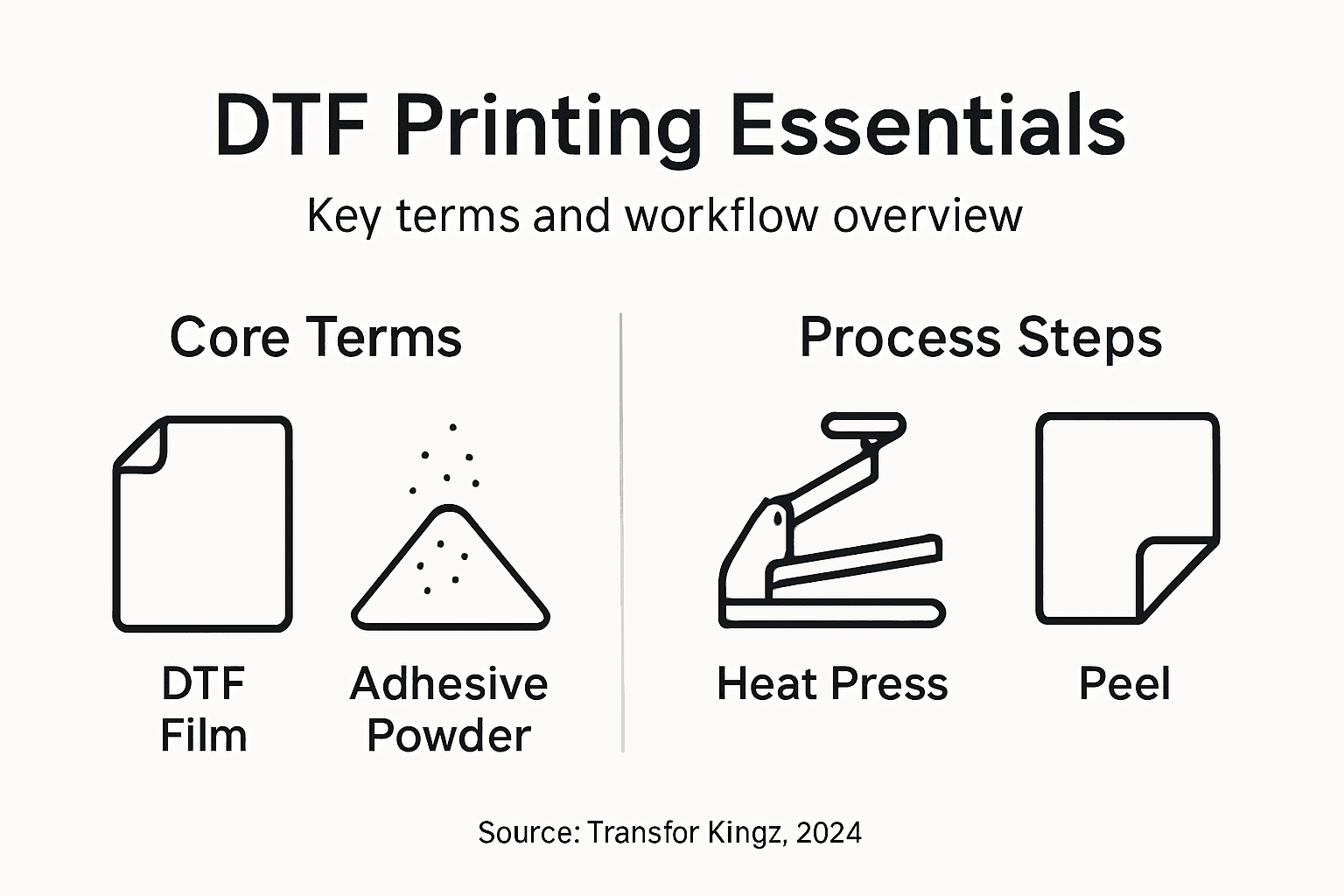
The foundational elements of DTF printing revolve around several key components that work together seamlessly:
- Film: The specialized transparent carrier that holds the printed design
- Adhesive Powder: The critical substance that enables image transfer and fabric adhesion
- CMYK Inks: Color processing inks used to create vibrant, detailed designs
- Transfer Process: The method of moving the printed image from film to fabric
Professional designers recognize that DTF printing terminology encompasses more than just basic definitions. Each term represents a critical step in transforming digital artwork into wearable, washable graphics. For instance, understanding concepts like air purging and cold peel can dramatically impact transfer quality and durability.
Successful DTF printing requires precise knowledge of technical processes. The transfer involves intricate steps: printing the design onto specialized film, applying adhesive powder, curing the image, and then heat pressing onto the target fabric. Each stage demands specific technique and understanding of the underlying technological principles.
Technical precision separates amateur designs from professional-grade transfers.
Pro tip: Always calibrate your equipment and test transfer settings before running full production batches to ensure consistent, high-quality results.
Types of DTF Films, Inks, and Powders
Designers navigating the world of Direct-to-Film (DTF) printing must understand the critical components that transform digital designs into high-quality fabric transfers. Essential transfer material types form the backbone of successful custom apparel production, with three primary elements playing pivotal roles: films, inks, and adhesive powders.
DTF transfer films are the foundation of the printing process, featuring unique characteristics that enable precise design reproduction:
- Transparent PET Films: Provide clear, crisp image transfer
- Silicone-Coated Films: Enhance ink adhesion and release properties
- Standard Weight Films: Suitable for most standard printing applications
- Premium Specialty Films: Designed for intricate, high-resolution designs
Color reproduction depends entirely on the CMYK ink system, which allows designers to create vibrant, complex graphics. Professional-grade DTF inks differ significantly from traditional screen printing or direct-to-garment alternatives. These specialized inks are formulated to:
- Maintain color vibrancy during transfer
- Provide excellent adhesion to various fabric types
- Ensure durability through multiple wash cycles
- Support intricate design details
Adhesive powders represent the often-overlooked hero of DTF printing. These specialized substances determine how effectively the printed design bonds with fabric:
- Hot-Melt Adhesive Powders: Standard option for most transfers
- Low-Temperature Powders: Ideal for heat-sensitive fabrics
- Flexible Adhesive Formulations: Enable stretch and movement in printed designs
The quality of your transfer materials directly impacts the final product’s appearance and longevity.
Pro tip: Invest in high-quality, manufacturer-recommended films, inks, and powders to consistently produce professional-grade custom transfers.
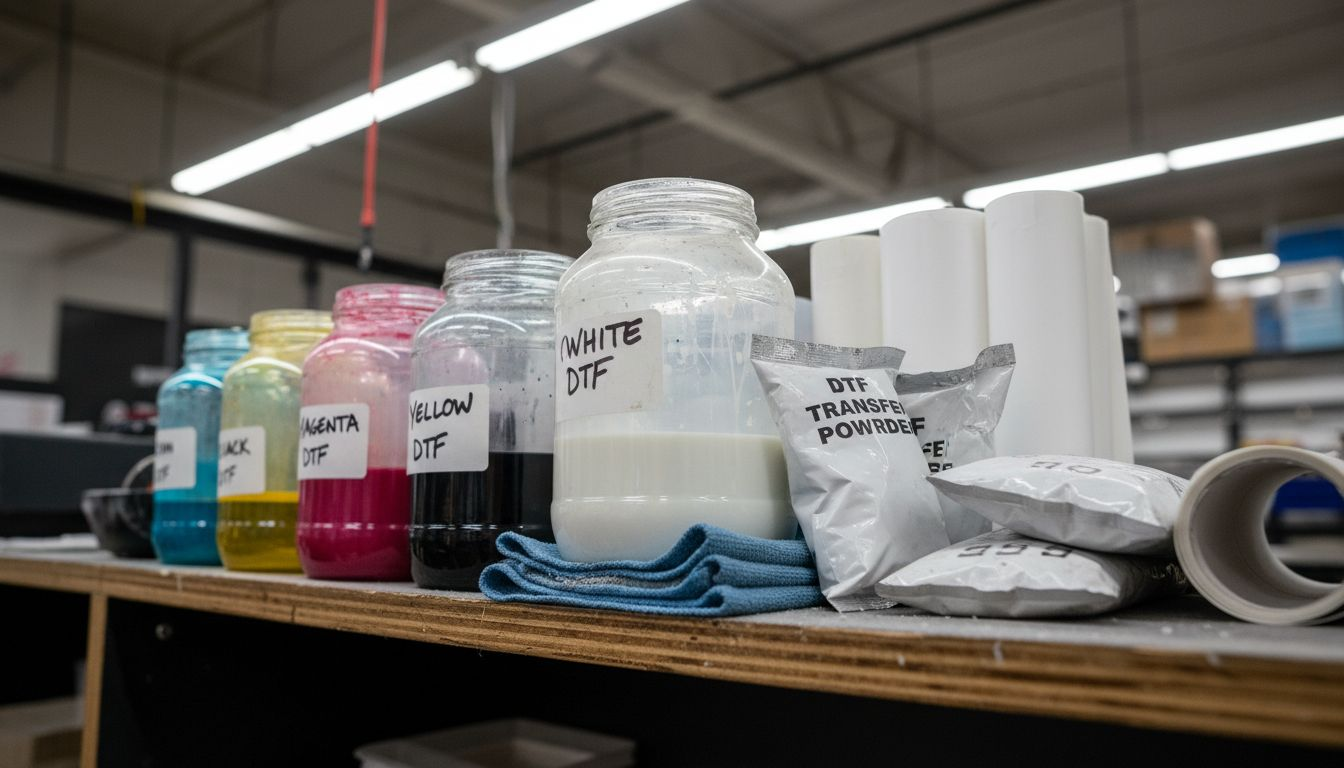
Here’s a quick comparison of DTF materials and their business impact:
| Material Type | Key Benefit | Common Application |
|---|---|---|
| PET Transfer Film | Enables crisp image transfer | Standard apparel graphics |
| CMYK Inks | Delivers vibrant colors | Detailed and vivid prints |
| Adhesive Powder | Secures design to fabric | Improving wash durability |
Application Methods and Transfer Processes
Direct-to-Film (DTF) printing demands precision and understanding of multiple application methods that transform digital designs into stunning fabric transfers. Top transfer techniques require mastery of several critical steps that ensure professional-quality results.
The DTF transfer process involves a meticulous sequence of technical steps:
- Digital Design Preparation
- Film Printing
- Powder Application
- Curing
- Heat Transfer
- Final Finishing
Each stage demands specific attention to detail and precise equipment handling. Film printing represents the initial critical phase, where high-resolution digital designs are printed onto specialized transfer films using advanced CMYK ink systems. This process requires:
- Calibrated printer settings
- High-quality transfer films
- Precise color management
- Optimal ink density
The powder application stage represents another crucial component of the DTF transfer process. Designers must evenly distribute adhesive powder across the printed film, ensuring complete and uniform coverage. Different adhesive powders provide unique characteristics:
- Hot-Melt Powders: Standard adhesion method
- Low-Temperature Powders: Ideal for delicate fabrics
- Flexible Formulations: Supporting stretch and movement
Heat transfer requires specialized equipment and precise temperature control. Professional designers must understand:
- Optimal heat press temperatures
- Appropriate pressure settings
- Transfer duration for different fabric types
- Cooling and post-transfer handling
Precision in each transfer stage determines the final product’s quality and durability.
Pro tip: Invest in a high-quality heat press with temperature and pressure controls to ensure consistent, professional DTF transfers.
Key Safety, Cost, and Quality Factors
Designers and business owners must navigate the complex landscape of DTF printing by understanding the critical interplay between safety protocols, production costs, and transfer quality. Heat press parameters play a pivotal role in determining the overall success of custom apparel production.
Safety considerations are paramount in DTF printing, involving multiple dimensions of operational risk management:
- Personal Protective Equipment (PPE)
- Ventilation Requirements
- Chemical Handling Protocols
- Equipment Maintenance Standards
Cost management represents another crucial aspect of professional DTF printing. Designers must strategically balance multiple economic factors:
- Initial equipment investment
- Ongoing material costs
- Ink and film expenses
- Labor and production time
- Waste reduction strategies
Quality control demands precise technical understanding and meticulous attention to detail. Critical quality factors include:
- Color consistency
- Image resolution
- Transfer durability
- Fabric compatibility
- Wash and wear performance
Temperature control emerges as a fundamental element determining print quality. Optimal heat press conditions typically require:
- Precise temperature range (around 170°C)
- Controlled dwell time (approximately 10 seconds)
- Consistent pressure application
- Appropriate cooling protocols
Mastering technical parameters transforms good designs into exceptional transfers.
Pro tip: Invest in a professional-grade digital heat press with programmable temperature and pressure settings to ensure consistent, high-quality DTF transfers.
Common Misconceptions and Pitfalls to Avoid
Designers venturing into Direct-to-Film (DTF) printing often encounter numerous misconceptions that can significantly impact their production quality and business success. DTF printing techniques require nuanced understanding beyond surface-level assumptions.
Common misconceptions about DTF printing include several critical misunderstandings:
- Myth: Any printer works for DTF transfers
- Reality: Specialized DTF printers are essential for quality results
- Myth: Temperature doesn’t matter much in transfers
- Reality: Precise temperature control determines print durability
- Myth: All transfer films are identical
- Reality: Film quality varies dramatically between manufacturers
Technical knowledge separates successful designers from amateur practitioners. Designers frequently make costly mistakes by:
- Overlooking film compatibility
- Ignoring printer calibration requirements
- Underestimating powder distribution importance
- Neglecting proper curing techniques
Equipment and material selection represent another complex area prone to misconceptions:
- Cheap materials lead to inferior transfers
- Incorrect ink selection compromises design integrity
- Inconsistent heat press settings create unpredictable results
- Inadequate workspace setup increases production errors
Professional DTF printing demands rigorous attention to detail and continuous learning. Designers must:
- Invest in quality training
- Understand equipment limitations
- Experiment systematically
- Document and analyze production outcomes
Expertise in DTF printing comes from understanding nuanced technical challenges.
Pro tip: Develop a systematic testing protocol for each new design and material combination to minimize unexpected transfer failures.
Here is a summary of common DTF pitfalls and how to avoid them:
| Pitfall | Effect on Results | Prevention Strategy |
|---|---|---|
| Using general printers | Poor transfer quality | Invest in DTF-specific hardware |
| Ignoring calibration | Inconsistent production | Run test prints regularly |
| Selecting cheap materials | Lower durability | Source quality supplies |
| Skipping post-transfer cooling | Designs may not adhere well | Follow full transfer protocols |
Elevate Your DTF Printing with Expert Transfers from Transfer Kingz
Navigating the detailed world of DTF terminology and mastering critical concepts like film types, adhesive powders, and precise heat transfer settings can feel overwhelming. If you aim to produce vibrant, durable designs and avoid costly pitfalls, relying on premium materials and trusted printing solutions is essential. Transfer Kingz offers a wide selection of DTF transfers crafted to meet professional standards so you can focus on creating without compromising quality.
Unlock the full potential of your custom apparel printing with top-grade films, inks, and powders all in one place. Whether you’re a hobbyist or running a high-volume shop, Transfer Kingz provides fast turnaround, no minimum orders, and expert guidance to ensure your transfers stand out and last. Visit Transfer Kingz today to explore our products and simplify your DTF printing journey with confidence.
Frequently Asked Questions
What is Direct-to-Film (DTF) printing?
Direct-to-Film (DTF) printing is a technique for creating custom apparel where designs are printed onto a specialized transparent film before being transferred to fabric using heat and pressure.
What are the core components involved in the DTF printing process?
The core components of DTF printing include the film (carrier for the design), adhesive powder (helps bond the design to the fabric), CMYK inks (for vibrant colors), and the heat transfer process (to apply the design to fabric).
Why is understanding DTF terminology important for designers?
Understanding DTF terminology is crucial for designers because it encompasses the technical aspects that affect the quality, durability, and overall success of the printed designs, ensuring professional-grade results.
How do different types of DTF films impact the printing process?
Different types of DTF films—such as transparent PET films, silicone-coated films, and premium specialty films—affect the clarity, adhesion, and overall quality of the printed designs, making the choice of film essential for achieving desired results.
Recommended
- DTF Printing Glossary: Essential Terms Explained – Transfer Kingz
- DTF Printing Terminology Explained: Master Every Step – Transfer Kingz
- What Is DTF Printing: Transforming Custom Apparel – Transfer Kingz
- What Is DTF Printing: Transforming Custom Apparel – Transfer Kingz
- How to Create Custom PPF Patterns Using Aeoncut: Step-by-Step Guide – AEONCUT PPF Pre-cut Cutting software
0 comments